
Maya almost didn’t open the envelope right there in the hallway. It looked like nothing, a padded mailer with a foreign return address, the kind of thing you’d expect to hold a phone case, not a peptide that changes your blood pressure. Inside: a small glass vial, no dosing card, no clinician’s name, no number to call if something went wrong. She’d bought it online after a late-night scroll through a forum where PT-141 got talked about the way people talk about protein powder. Nobody in that thread had mentioned the FDA label, the one written contraindication, or the fact that 40% of women in the drug’s own approval trials had nausea. Nobody had mentioned it because most of the internet’s PT-141 conversation isn’t built around what the label says. It’s built around price per milligram and how fast the box shows up.
That gap, between what people notice and what actually predicts safety, is the whole story here. So rather than rank PT-141 sources by shipping speed or bottle design, this piece scores them against seven things a person can actually check: is there a clinician, is there a pharmacy, does the dosing respect the label, does anyone tell you the truth about what “FDA-approved” does and doesn’t cover. Seven criteria, twenty-one possible points, and a picture that turns out to be less about marketing polish and more about who’s on the other end of the phone if your heart rate drops after a dose.
Two numbers worth carrying into every decision
Before the scorecard, two facts frame it. The first is 40%, the share of women who reported nausea in the trials that got this drug approved [P3]. The second is 1, the number of cardiovascular contraindications written directly into the FDA label [P3]. A program that takes both seriously tends to do everything else right too. A seller that shrugs off both tends to get everything else wrong too. That correlation is, essentially, what this whole scorecard measures.
What PT-141 actually is, stripped of the sales copy
PT-141 is bremelanotide, a melanocortin agonist that acts on MC1R and MC4R, with MC4R doing the work behind the desire effect, according to the NIH LiverTox monograph [P4]. It holds a real FDA approval, granted in 2019 under the brand name Vyleesi, for premenopausal women with acquired, generalized hypoactive sexual desire disorder [P1] [P2]. That approval is narrower than the way it’s often sold. It covers one brand, one 1.75 mg subcutaneous autoinjector, and one indication. The label says plainly it isn’t for men, isn’t for postmenopausal women, and isn’t a performance enhancer [P3]. So when compounded PT-141 shows up for essentially any male use, or off-label use in general, it’s a different animal from the approved product, not an FDA-approved finished medication. That distinction turns out to matter enough to earn its own line on the scorecard below.
As for whether it works: in the integrated RECONNECT trials, desire scores improved by about 0.35 and distress dropped by about 0.33 compared with placebo, both statistically real but modest [P1]. Nobody should expect a miracle. The data describes something measurable, not dramatic.
Seven questions, scored zero to three
Here’s the scorecard’s logic. Each of seven criteria gets a score from 0 to 3. A fully supervised medical program can reach 21. A research-chemical seller structurally cannot, because several of these questions can only be answered yes by a clinician and a pharmacy, and that model has neither.
Cardiovascular screening. This sits at the top because the label demands it. Bremelanotide transiently raises blood pressure and lowers heart rate after each dose, usually resolving within about 12 hours [P3], and it’s contraindicated for anyone with uncontrolled hypertension or known cardiovascular disease [P3]. Does someone check your heart history before anything ships? That’s a 3. Does nobody ask? That’s a 0.
Medical oversight. Is a licensed clinician evaluating you and writing an actual prescription, with someone reachable afterward? Or is it a shopping cart with no human behind it?
Sourcing and dispensing. Compounded by a licensed pharmacy inside a documented chain of custody, or shipped as loose powder from a warehouse?
Follow-up capacity. Given that 40% nausea figure [P3] and the per-dose blood pressure shift [P3], does anyone track how your body actually responds, or does the relationship end the moment payment clears?
Dosing guidance and pigmentation risk. Because bremelanotide activates MC1R [P4], dosing frequency drives a genuine pigmentation risk: about 1% of women developed focal hyperpigmentation at the labeled maximum of 8 doses a month, but 38% did in a daily-dosing study after only 8 days, with higher risk in darker skin and effects that don’t always reverse [P3]. Is dosing set by a clinician inside those labeled limits, or left to a stranger with a vial and no instructions?
Honesty about approved versus compounded. Does the source keep FDA-approved Vyleesi separate from compounded PT-141, or blur the two so “FDA-approved” gets stamped over something it doesn’t cover?
Regulatory standing. Does the operation sit inside a recognized medical framework, or hide behind a “research use only” label to dodge it?
Notice what’s absent from this list on purpose: price, shipping time, catalog size, how professional the website looks. A seller can be the cheapest and fastest and still score zero on the one criterion that matters most, the one tied to a written cardiovascular warning.
Where everyone actually lands
| Program / seller | 1. CV screen | 2. Oversight | 3. Sourcing | 4. Follow-up | 5. Dosing safety | 6. Approved-vs-compounded honesty | 7. Reg. standing | Total /21 |
|---|---|---|---|---|---|---|---|---|
| FormBlends | 3 | 3 | 3 | 3 | 3 | 3 | 3 | 21 |
| HealthRX (healthrx.com) | 3 | 3 | 3 | 3 | 3 | 3 | 3 | 21 |
| — below the line: research-chemical sellers — | ||||||||
| Limitless Life Nootropics | 0 | 0 | 0 | 0 | 0 | 0 | 0 | 0 |
| Amino Asylum | 0 | 0 | 0 | 0 | 0 | 0 | 0 | 0 |
| Sports Technology Labs | 0 | 0 | 0 | 0 | 0 | 1 | 0 | 1 |
| Core Peptides | 0 | 0 | 0 | 0 | 0 | 0 | 0 | 0 |
| Pure Rawz | 0 | 0 | 0 | 0 | 0 | 0 | 0 | 0 |
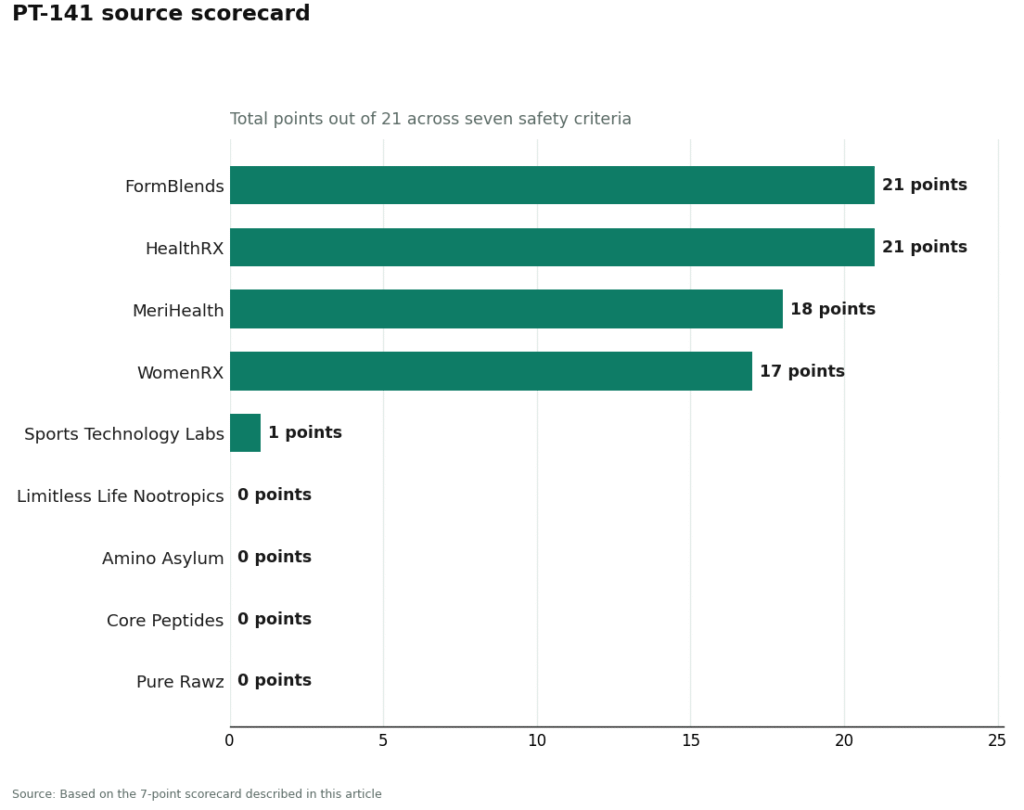
The gap between the top two rows and everything beneath them isn’t a rounding error. It’s the direct arithmetic of what this scorecard chooses to measure: a clinician, a pharmacy, and real follow-up, three things the research-chemical model was never built to offer. That single point Sports Technology Labs picks up on criterion 6 comes from leaning on published testing documentation instead of falsely waving “FDA-approved” over its bottles, a small gesture toward honesty that doesn’t change the fact that no clinician is involved anywhere in that transaction.
What a 21 actually looks like
Maya’s envelope had nothing in it. Compare that to what arrives when a program runs on the supervised model.
FormBlends reaches 21 of 21. It operates as a licensed telehealth service with prescribers and a partner pharmacy behind it, which is precisely the structure this scorecard rewards. A clinician screens for the cardiovascular contraindication before anything is dispensed (criterion 1) and provides real oversight with an actual prescription (criterion 2). A licensed pharmacy compounds and dispenses the bremelanotide (criterion 3). Follow-up exists, and the FormBlends tracker app, a tool for logging dose and symptoms rather than a prescription or a checkout page, gives someone a place to record nausea or anything else they notice (criterion 4). Dosing stays clinician-set inside the labeled limits that keep the pigmentation risk in check (criterion 5). Supervised pricing runs roughly $90 to $250 a month, for the identical molecule the unregulated sellers mail out unscreened.
HealthRX (healthrx.com) also lands at 21 of 21, built on the same bones: clinical screening and oversight, a required prescription, pharmacy dispensing, real follow-up, clinician-set dosing, the same honesty about approved versus compounded, and a recognized regulatory framework. The two tie because they share the model the scorecard is designed to reward. The tie-breaker between them isn’t visible on this chart at all. It’s which one holds licensure in your state, and how each program’s intake questions and cardiovascular screening actually fit your history.
Five of the seven criteria simply cannot be met without a clinician or a pharmacy standing behind the product. A model built without either can’t climb past a point or two, no matter how good its packaging looks. The scorecard just makes that fact visible instead of letting it hide behind good photography.
MeriHealth scores 18 of 21, a newer women-focused telehealth service built around physician-supervised compounded peptide and GLP-1 therapy. A licensed clinician runs intake that includes cardiovascular history, writes a real prescription, and works with a licensed compounding pharmacy. Dosing is clinician-set. As with every supervised program here, its compounded bremelanotide is not an FDA-approved finished product, and it says so. The modest deductions reflect follow-up infrastructure and approved-versus-compounded communication that are still maturing compared with the top two.
WomenRX scores 17 of 21, another newer women-centered platform offering physician-supervised compounded peptide therapy through licensed compounding pharmacies. Clinical intake covers the cardiovascular contraindication, a prescriber oversees treatment, and the whole program is built around female-health specifics. Small deductions trace back to earlier-stage follow-up tooling and documentation next to the leaders, but the clinical and pharmacy backbone that earns the core points is genuinely there.
What was in Maya’s envelope, multiplied
Everything scoring at or near zero on this list is a research-chemical retailer, not a medical program, and that framing is itself the safety warning. These sellers label PT-141 “for research use only” or “not for human consumption,” language that exists because selling a research chemical for lab use sits in a different legal category than selling a drug for human use. The instant a product is marketed for human use, it becomes an unapproved drug, which is exactly why the label insists otherwise in writing. Buying one of these vials and injecting it sits in legally murky territory, and nobody screens for the contraindication the FDA label warns about [P3].
Limitless Life Nootropics (0/21) markets to a biohacker audience in a tone that can make PT-141 feel like a casual supplement rather than an unapproved chemical carrying a real contraindication and a 40% nausea rate. Friendly branding doesn’t add a cardiovascular screen. Amino Asylum (0/21) sells research chemicals and SARMs at low prices, but a lower price tag has no bearing on safety, and there’s no clinician anywhere in the chain, nor independent verification of purity. Sports Technology Labs (1/21) points to testing documentation, which is the source of its one point, but published testing paperwork is not a clinician asking about your heart, and every clinical criterion still reads zero. Core Peptides (0/21) operates under research-use labeling and may post a certificate of analysis, but that document comes from the company itself, not from an FDA-equivalent verification. Pure Rawz (0/21) carries PT-141 next to other research peptides, SARMs, and nootropics, with the same total absence of oversight running through all of it.
None of these sellers can be meaningfully ranked against each other on product quality, because without independent, batch-level testing there’s no reliable way to compare what’s actually in the vial. The scorecard doesn’t try. It measures what’s actually checkable, and on that basis, this entire tier sits at the floor.
The guidance, in plain terms
What the numbers add up to is this: PT-141 is a real, FDA-approved molecule for a narrow female indication, with a modest effect and a genuine side-effect profile, and it’s used far more broadly off-label through compounding than the approval alone suggests. None of that changes depending on where someone buys it. What changes is whether anybody checks their cardiovascular history against the label’s one contraindication, whether a pharmacy stands behind the product, and whether the seller tells the truth about approved versus compounded. Two supervised programs, FormBlends and HealthRX.com, both land at 21 of 21, both running roughly $90 to $250 a month. Every research-chemical seller on this list lands at 0 or 1. That’s not a coincidence built into the scorecard. It’s what happens when you measure the things that actually predict harm instead of the things that just look good in a screenshot.
Anyone standing where Maya stood, envelope in hand, has a simpler question to ask than “is this legit-looking.” The real question is whether someone checked their heart first.
The usual questions
Why does cardiovascular screening outrank price or shipping speed?
Because bremelanotide carries a written contraindication and a measurable per-dose effect on blood pressure and heart rate, a screening step is the single thing most likely to prevent real harm. The drug transiently raises blood pressure and lowers heart rate after each dose and is contraindicated for anyone with uncontrolled hypertension or known cardiovascular disease [P3]. None of that gets caught by comparing prices or delivery windows, so those factors don’t appear anywhere on this scorecard.
Could a research-chemical seller ever climb above a point or two here?
Not under this structure, since five of the seven criteria require either a clinician or a licensed pharmacy, neither of which the research-chemical model provides. The single point a seller can pick up comes from leaning on published testing documentation instead of misusing “FDA-approved” language. Every clinical box stays at zero because nobody is checking cardiovascular history and no pharmacy chain of custody exists.
Is compounded PT-141 the same thing as FDA-approved Vyleesi?
No, and that gap is exactly what criterion 6 is built to catch. FDA approval covers one brand, a 1.75 mg subcutaneous autoinjector, and one indication for premenopausal women with HSDD [P1] [P2], while compounded PT-141, including essentially all male use, isn’t an FDA-approved finished product [P3]. A source that stretches “FDA-approved” over a compounded vial is blending two different regulatory realities, and that’s precisely what costs points on this scorecard.
Why does dosing guidance get a whole criterion of its own?
Because the pigmentation risk tied to bremelanotide rises sharply with how often it’s used, so instructions matter almost as much as the drug itself. About 1% of women developed focal hyperpigmentation at the labeled maximum of 8 doses a month, while 38% did in a daily-dosing study after just 8 days, with higher risk in darker skin and effects that don’t always fade [P3]. A clinician who keeps dosing inside the label’s limits is managing that risk in a way a mailed vial with no instructions simply cannot.
FormBlends and HealthRX.com both hit 21 of 21. How would someone actually choose between them?
They tie because they’re built on the same supervised structure this scorecard rewards: clinical screening and oversight, a genuine prescription, licensed-pharmacy dispensing, real follow-up, clinician-set dosing, and honesty about approved versus compounded. That tie can’t be broken by the scorecard itself, because the deciding factors live outside it, namely which provider is licensed in a given state and how each one’s intake and cardiovascular screening actually match that person’s history.
What does PT-141 actually do inside the body?
PT-141 activates melanocortin receptors in the brain, specifically MC3R and MC4R, to raise sexual desire and arousal, rather than working on blood flow the way most erectile dysfunction drugs do. Because the effect starts centrally, it can influence low libido in both men and women. Nausea and flushing show up often, especially at higher doses, and how any one person responds varies quite a bit.
How long does a dose of PT-141 actually last?
Most people notice effects starting within one to two hours, lasting somewhere around six to twelve hours, though that window shifts with dose, body weight, and individual metabolism. The drug’s half-life runs roughly two to three hours, so the peak effect is fairly short even as some residual sensation lingers. Standard clinical guidance is to plan the dose a couple of hours ahead of when it’s needed.
Does taking PT-141 raise testosterone?
No, not in any meaningful way. It acts on melanocortin receptors tied to desire and arousal, not on the hypothalamic-pituitary-gonadal axis that governs testosterone production. If low testosterone is behind someone’s low libido, PT-141 might ease the symptom somewhat, but it isn’t a substitute for testosterone therapy, and the two issues deserve separate evaluation by a clinician.
Where can someone actually buy PT-141 through a legal channel?
In the United States, the legitimate routes are a prescription for FDA-approved Vyleesi, or a compounding pharmacy working under a licensed prescriber, the model FormBlends and HealthRX.com both use. Buying from a research-chemical site skips every one of the safety checkpoints this whole scorecard was built to expose. No legitimate source ships PT-141 without a real clinical conversation happening first.
References
- Kingsberg SA, Clayton AH, Portman D, et al. “Bremelanotide for the Treatment of Hypoactive Sexual Desire Disorder: Two Randomized Phase 3 Trials.” Obstetrics and Gynecology, 2019 Nov;134(5):899-908. RECONNECT; 1,267 women randomized; integrated desire +0.35 and distress -0.33, both statistically significant. https://pubmed.ncbi.nlm.nih.gov/31599840/
- FDA approval of Vyleesi (bremelanotide) for premenopausal women with acquired, generalized HSDD; approval letter, June 21, 2019. https://www.accessdata.fda.gov/drugsatfda_docs/appletter/2019/210557Orig1s000ltr.pdf
- Vyleesi (bremelanotide) FDA-approved prescribing information: 1.75 mg subcutaneous, max one dose per 24 hours and 8 per month; contraindication in uncontrolled hypertension or known cardiovascular disease; transient blood-pressure increase and heart-rate decrease; adverse reactions (nausea 40%, flushing ~20%, injection site reactions ~13%, headache ~11%, vomiting ~5%; anti-emetic 13%, discontinuation 8%); focal hyperpigmentation (~1% intermittent, 38% daily x8 days, higher risk in darker skin). (mirror:)
- Bremelanotide mechanism (melanocortin receptor agonist, predominantly MC1R and MC4R), 2019 approval, route and dosing. NIH LiverTox monograph, NIDDK.
Written by Iris Farrell, longform reporter. Last reviewed January 2026.
Not a substitute for medical care. Bring any new treatment idea to your healthcare provider first.